Lucy Strauss
INFORMATION:
about ︎
publications ︎
contact ︎
about ︎
publications ︎
contact ︎
night swim ︎
amass ︎
signal space ︎
improvisation ︎
tele-improvisation ︎
sonic response ︎
darkroom performances ︎
instance ︎
video archive ︎
project blog ︎
about
Lucy Strauss is a musician and researcher drawing together viola performance, impovisation, composition & creative computing. With these practices, she seeks to deepen understanding of musicmaking with new and old technologies.
Lucy has performed in improvised and experimental music projects at Pony Books (Gothenburg), the TD Vancouver International Jazz Festival, Mixtophonics Festival, 8EAST Cultural Center & NOW Society (Vancouver), De Tanker (Amsterdam), Hundred Years Gallery (London), and Theatre Arts (Cape Town). She also enjoys contributing to interdisciplinary collaborations with fellow artists. Recently, she was the interaction designer for Denise Onen’s sounding the body as a sight at The Oscillations Exhibition 2024 (Akademie der Künste, Berlin), and an artist and mentor at the MusicDance Cape Town performance residence for interdisciplinary instant-composition. Additionally, Lucy has coded, composed and played for installations by visual artist Mia Thom at Everard Read Gallery, Act of Brutal Curation Gallery, and Eclectica Contemporary (Cape Town), as well as the 2022 Biennale de l'Art Africain Contemporain (Dakar). Lucy has presented workshops on composition (University of British Columbia), improvisation (Canadian Viola Society) and interactive music technology (Bowed Electrons Festival & Symposium).
Recent highlights include a ︎student artist residency at TATE in London, a ︎studio recording residency at at The Studio for Electroacoustic Music, Akademie der Künste in Berlin, and mentoring and performing at the ︎MusicDance Cape Town artist residency.
Lucy learnt to love improvising at the MusicDance021 artist residency (ZA). She further developed her improvisation practice at 8EAST & Now Society (CA). She learnt to compose music at the University of Cape Town (BMus) and perform viola at the University of British Columbia (MMus). For two years, Lucy was an Artist in Residence at the University of Johannesburg (ZA). She is currently an AHRC CHASE -funded PhD researcher in Arts & Computational Technology at Goldsmiths, University of London (UK). She specialises in deep generative modeling of audio & electromyographic signals from viola performance, towards cross-modal muscle-sound machine translation in interactive music system design.
Lucy is based in Gothenburg (SE) and London (UK).


PROJECTS
︎︎︎
PROJECTS
︎︎︎
VLA + MLMLMLM
In essence, the performance is a superimposed soundworld of what I actually play and what I probably play, based solely on the bioelectricity running through my muscles, a study of musical meaning within and outside of the performing body
dataset
MLMLMLM is trained on a custom dataset of time-aligned audio and electromyographic signals that I collected from my own body as I played viola during a residency at the The Studio for Electroacoustic Music, Akademie der Künste in Berlin, July 2025. I wrote about the residency on Substack.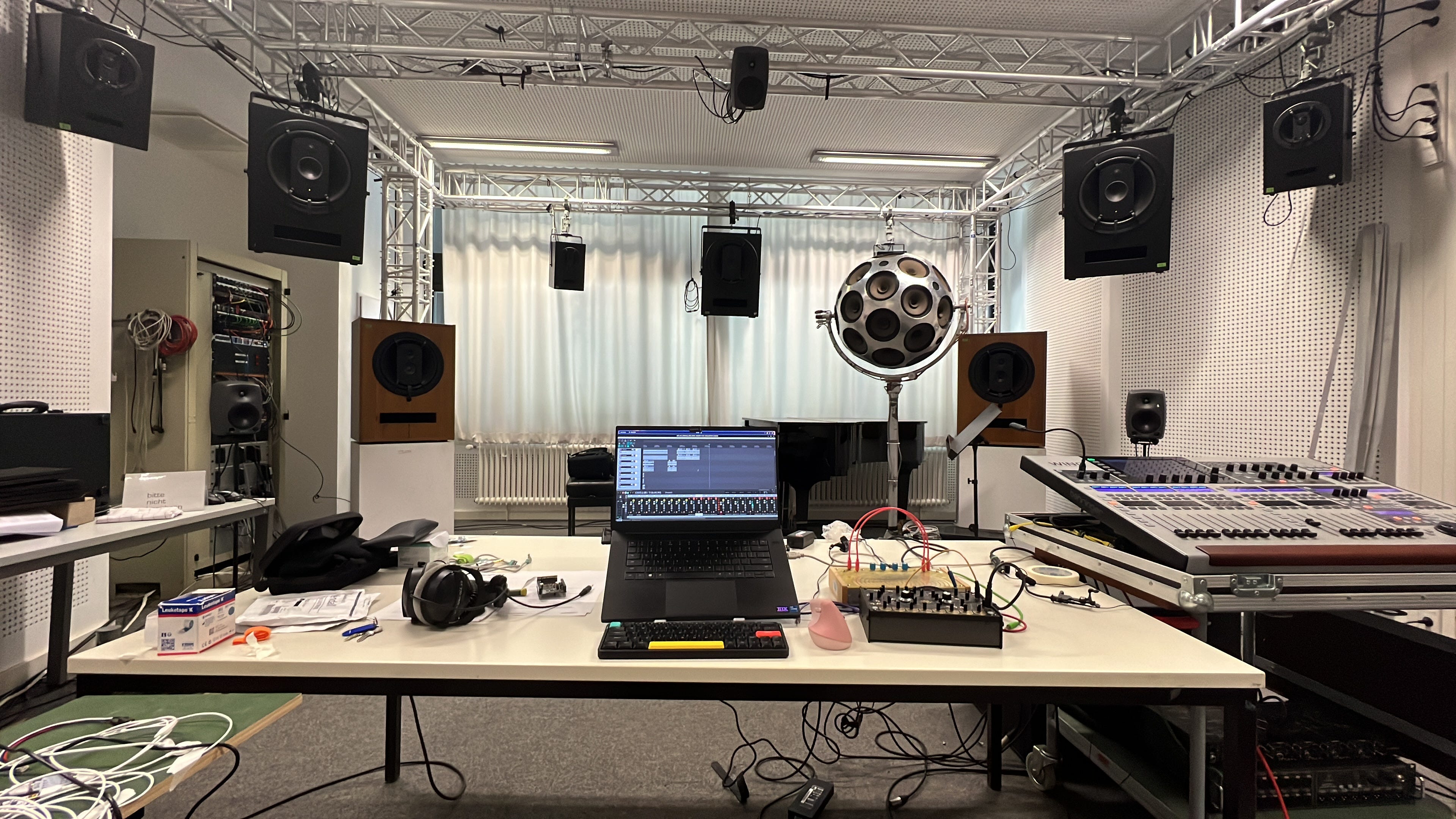 With a human-centred approach to computing, VLA + MLMLMLM brings to light experiential dimensions of viola playing that are typically hidden from the audience. As such, we listen through emergent aesthetics of machine listening -- through muscles.
 publication:
Strauss, L., Thattai Ravikumar, P., Yee-King, M. ‘Cross-Modal Sig2Sig Machine Translation with Deep Generative Modeling for NIME Design’. International Conference on New Interfaces for Musical Expression, 2026. [https://doi.org/10.5281/zenodo.20784411]
︎ GitHub repository
︎ newsletter / blog
Strauss, L., Thattai Ravikumar, P., Yee-King, M. ‘Cross-Modal Sig2Sig Machine Translation with Deep Generative Modeling for NIME Design’. International Conference on New Interfaces for Musical Expression, 2026. [https://doi.org/10.5281/zenodo.20784411]
︎ GitHub repository
︎ newsletter / blog
past performances:
21/03/2026 | Delft, NL | For Love of the World: Digital Revolt @ TU Delft
26/02/2026 | Göteborg, SE | Open Process Night @ Skogen
29/11/2025 | Cape Town, ZA | Bowed Electrons Festival & Symposium
21/03/2026 | Delft, NL | For Love of the World: Digital Revolt @ TU Delft
26/02/2026 | Göteborg, SE | Open Process Night @ Skogen
29/11/2025 | Cape Town, ZA | Bowed Electrons Festival & Symposium
Gained In Translation
words prompt sounds
sounds prompt words
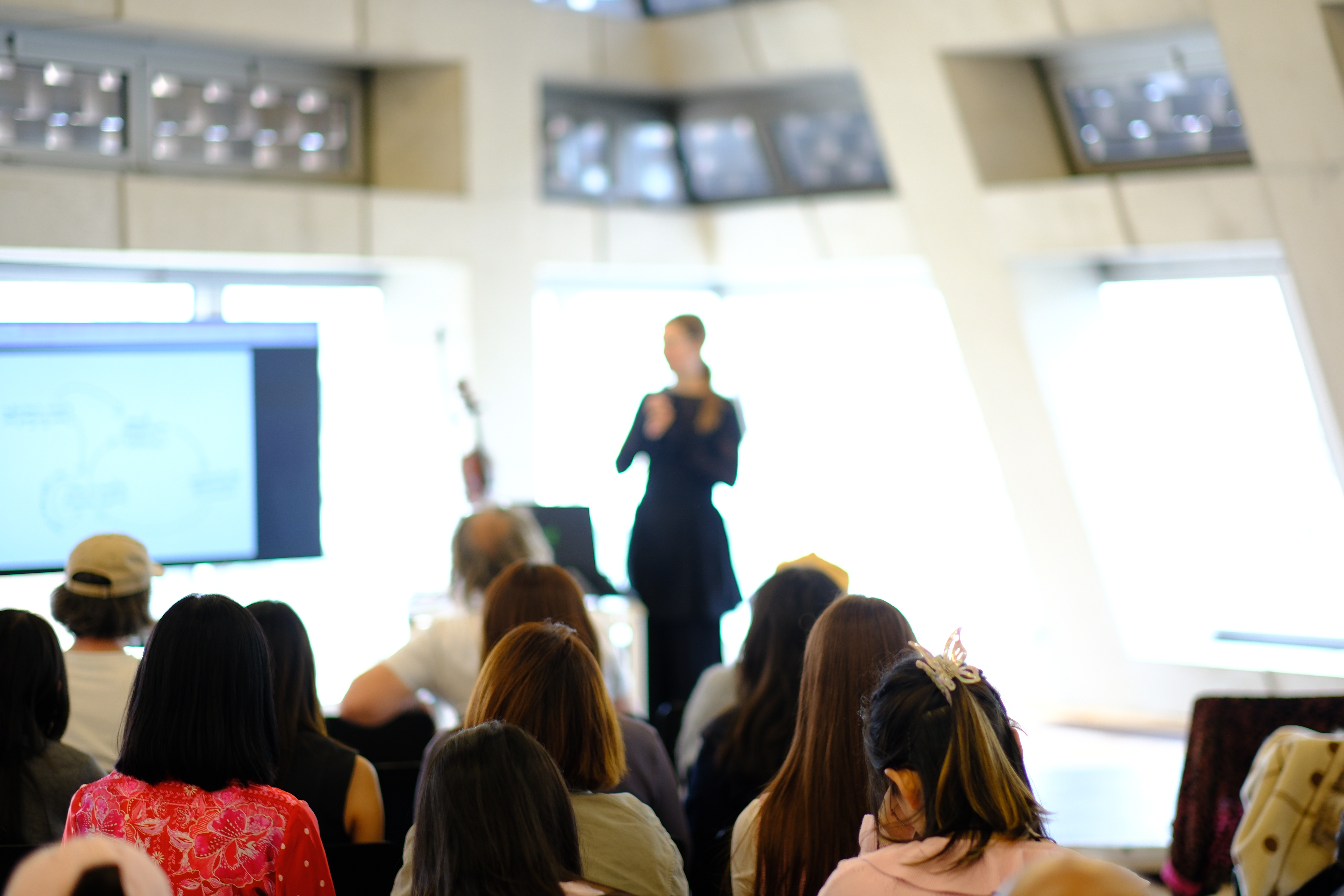
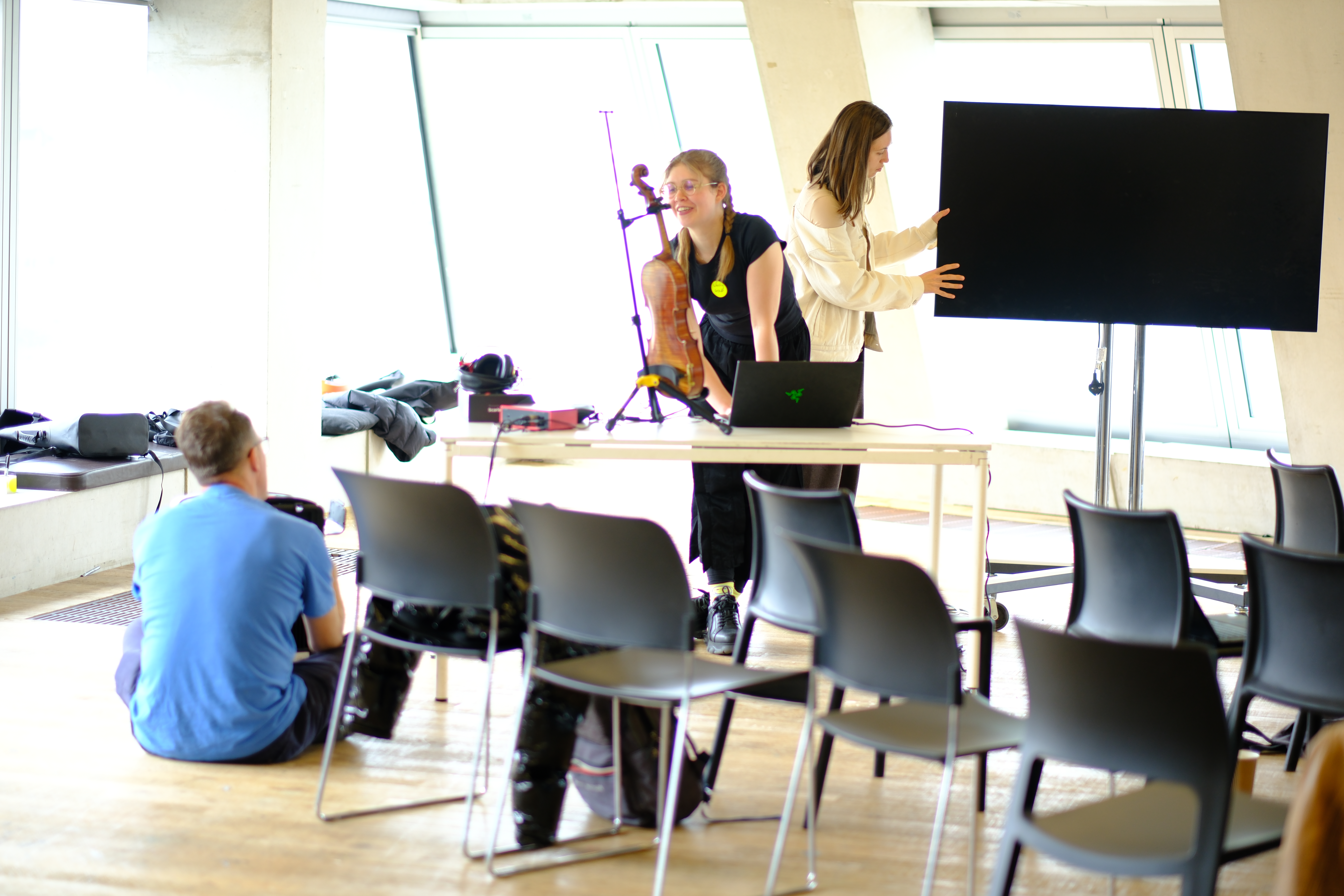


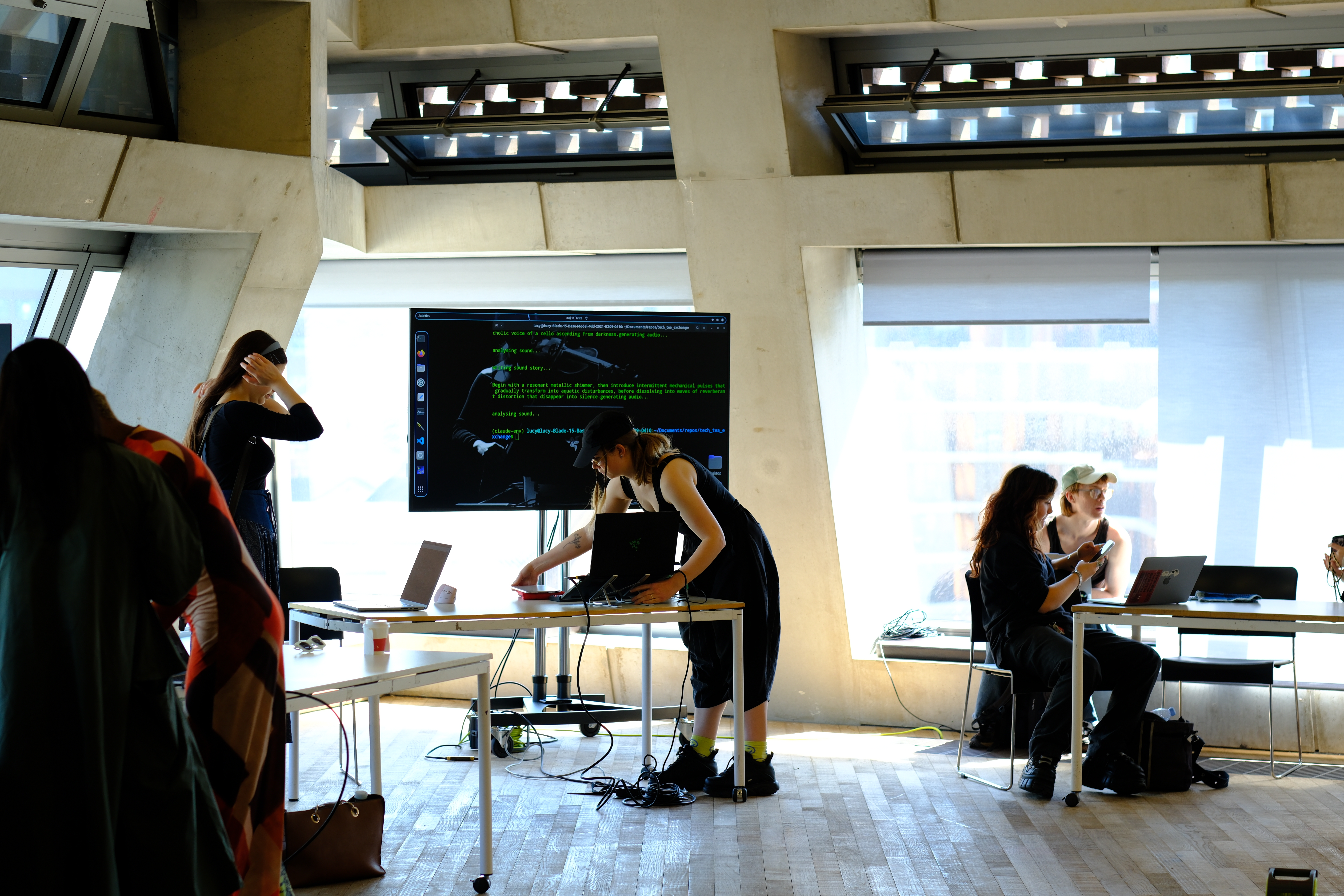

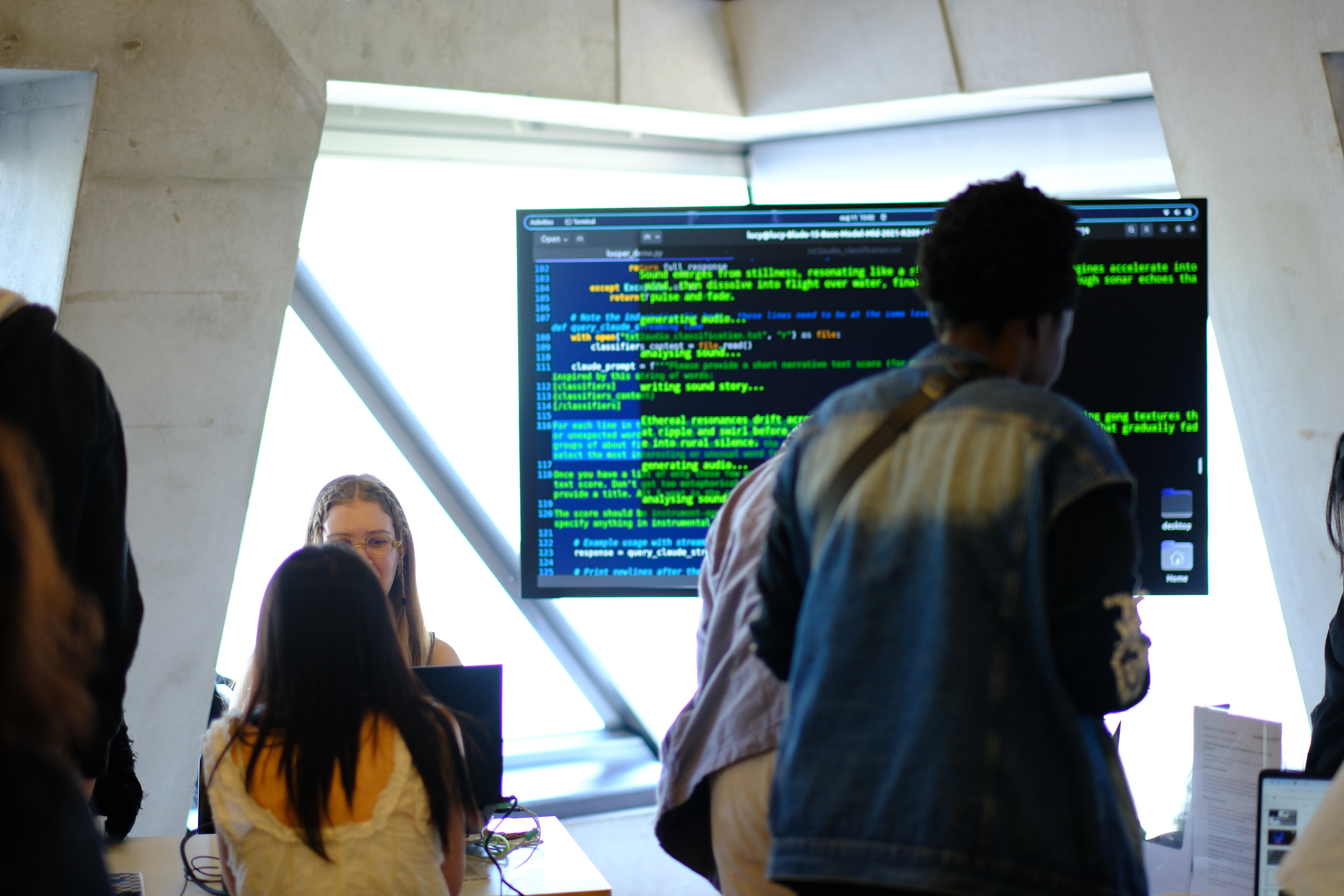
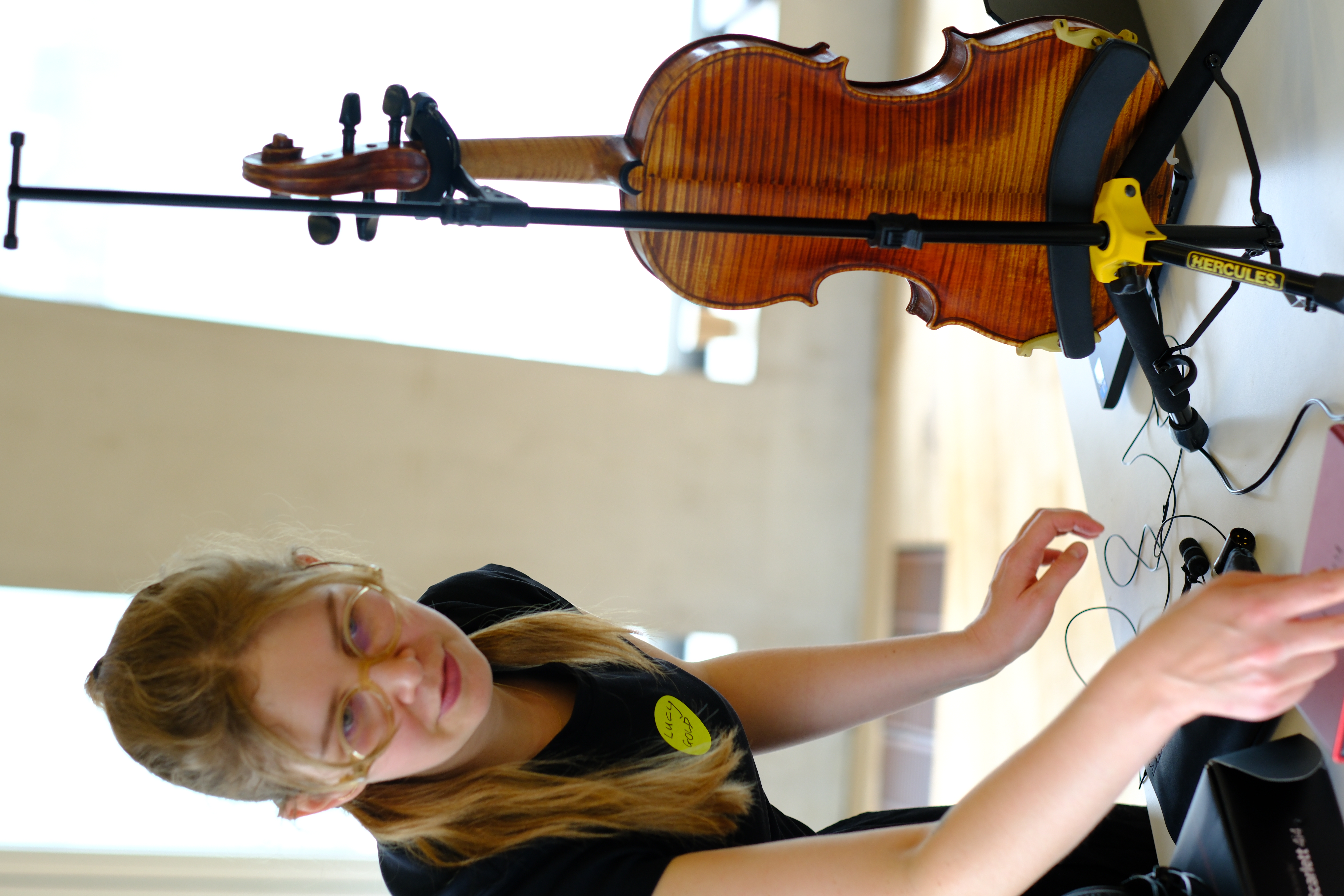
photos by Robin Leverton
Gained In Translation is a music & text performance piece that I made in May 2025 for the Tech, Tea & Exchange residency at Tate.* The piece comprises different Machine Learning (ML) models strung together to form a recursive loop. The loop begins with human input: a short musical phrase that I play on viola in response to a text score.
text as score
failure to copy

cross-modal translation as meta-composition
what is gained in translation?
*The Tech, Tea & Exchange residency was supported by Anthropic and Gucci.
I provide a︎Github repository for this project.
examples
The piece is different each time it is performed, even if the initial audio is identical:
In the example videos, the generated text features references to battle and to music practices that I have no connection to. These references emerged as a result of the class labels of the pre-trained YAMNet model, and were likely further amplified by the recursive loop between the (also pre-trained) Stable Audio and Claude AI models featured in this piece. I would never have purposefully guided the piece towards violent themes and cultural appropriation. However, I have intentionally left these emergent themes in the piece to reveal nature of the models and their training datasets.
models & datasets
YAMNet - a sound classification model from TensorFlow
The model is trained to predict the most probable sound in an audio waveform. We can predict sounds from a pre-recorded sound file (as I do for the tech demo version of Gained in Translation) or from an incoming stream of audio (as I do in the Gained in Translaton performance).
dataset - "AudioSet consists of an expanding ontology of 632 audio event classes and a collection of 2,084,320 human-labeled 10-second sound clips drawn from YouTube videos" https://research.google.com/audioset/
The model is trained to predict the most probable sound in an audio waveform. We can predict sounds from a pre-recorded sound file (as I do for the tech demo version of Gained in Translation) or from an incoming stream of audio (as I do in the Gained in Translaton performance).
dataset - "AudioSet consists of an expanding ontology of 632 audio event classes and a collection of 2,084,320 human-labeled 10-second sound clips drawn from YouTube videos" https://research.google.com/audioset/
Claude 3.7 Sonnet - a large language model created by Anthropic
dataset - "Training data includes public internet information, non-public data from third-parties, contractor-generated data, and internally created data. When Anthropic's general purpose crawler obtains data by crawling public web pages, we follow industry practices with respect to robots.txt instructions that website operators use to indicate whether they permit crawling of the content on their sites. We did not train this model on any user prompt or output data submitted to us by users or customers." - https://www.anthropic.com/transparency
dataset - "Training data includes public internet information, non-public data from third-parties, contractor-generated data, and internally created data. When Anthropic's general purpose crawler obtains data by crawling public web pages, we follow industry practices with respect to robots.txt instructions that website operators use to indicate whether they permit crawling of the content on their sites. We did not train this model on any user prompt or output data submitted to us by users or customers." - https://www.anthropic.com/transparency
Stable Audio 2.0 (text & audio-to-audio)
dataset - "AudioSparx is an industry-leading music library and stock audio web site that brings together a world of music and sound effects from thousands of independent music artists, producers, bands and publishers in a hot online marketplace." https://www.audiosparx.com/
dataset - "AudioSparx is an industry-leading music library and stock audio web site that brings together a world of music and sound effects from thousands of independent music artists, producers, bands and publishers in a hot online marketplace." https://www.audiosparx.com/